Wednesday, July 01, 2009

Oklahoma Boomer Quilt Block Pattern

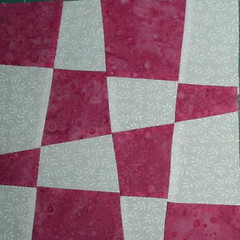
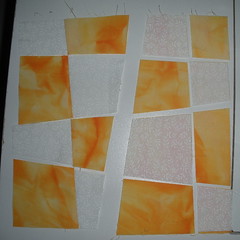
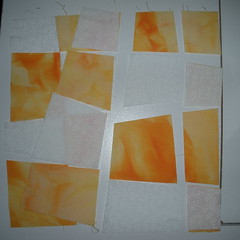
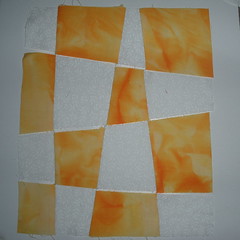
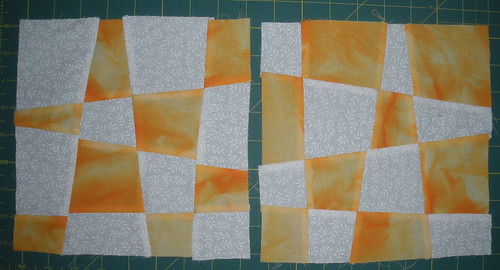
Sophie's Oklahoma Boomer Block
The Ladies Art Company first published the Oklahoma Boomer block in 1898. I have always loved this block and couldn't resist including it for the block lotto in our year of traditional blocks . . . it's just a happy coincidence that I saw a production of The Wizard of Oz a couple weekends ago and keep seeing the Tin Man, an alternate name you might see used, as in Judy Hopkins & Nancy Martin’s 101 Fabulous Rotary-Cut Quilts.

For those who happen to have a copy of Judy Hopkins & Nancy Martin’s 101 Fabulous Rotary-Cut Quilts, I will reference the same Alpha characters for each piece, so you can reference your book, it is helpful to you. Their version of the block is the same size (6 inches, finished size) but is made from three fabrics, instead of our two color blocks.

The main challenge in making this block is careful measuring and cutting and sewing that 1/4-inch seam. You also have an opportunity to make and work with a template.

Fabrics

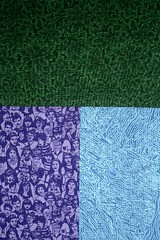
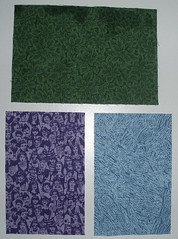
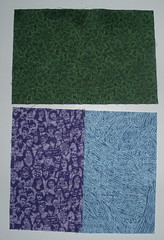
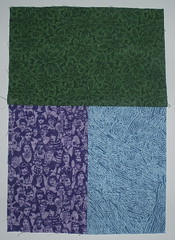
For the July Block Lotto, we'll be making this block in two colors, a cream tone-on-tone (TOT) print BACKGROUND fabric and your choice of RED or BLUE TOT main (BOOMER) fabric.

Make a template

If you were making multiple blocks from the same fabric (or don’t mind wasting some fabric), you would cut the large triangle head (A) by cutting a 3 1/4 inch square and cutting it twice diagonally. But since I’m going to tell you that you cannot repeat your BOOMER fabric in more than one block . . . the easiest thing to do is to make a template for that triangle. If you have card stock or template plastic, you can make a template by cutting a 3 1/4 inch square and cutting it twice diagonally and using one of the triangles for your template for the head (A). If you don’t, grab a standard size business card.


Make a Template from a Business CardMost standard sized business cards are 2” x 3.5”


Flip it over
It will probably be easier to work with from the back, so flip it over.


Trim to 3 -1/4 inches
Ttrim it so that it’s 3 1/4 inches wide.


Cut 45 degree angle from cornerAlign the 45-degree line on your ruler along the bottom edge and cut an angle from the bottom right corner.


Cutting second 45 degree angle
Flip over your card and repeat. Your template is ready to use.


Cutting


Using Your Template to Cut Head TriangleUse the template to cut the Head (A) piece from your BOOMER fabric by aligning the longest edge on grain on your fabric.

Again, if you don't mind wasted fabric, you can also cut a 3-1/4 inch square and cut it diagonally twice and use ONLY one of the resulting triangles.

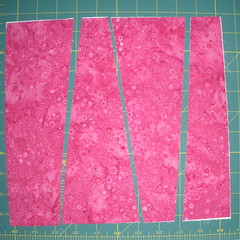
Cutting Main fabric
For the rest of the BOOMER pieces, you'll need:
One 1” square for neck (B)
Two rectangles, 1” x 2-1/2” for arms (C)
One rectangle, 2-1/4”x 2-1/2” for body (D)
Two rectangles 1” x 3-1/4” for legs (E)

Cutting Diagram
From the BACKGROUND fabric, cut:
Two rectangles, 2” x 2-1/2” for above arms (F)
Two rectangles 2-1/2” x 4-1/2” for below arms (G)
One 1-7/8” square cut once diagonally into two triangles, for sides of head (H)
Two 1” x 1-1/4” rectangles for sides of neck (I)
One 1-1/2 x 3-1/4” rectangle for between legs (J)


Sewing the Block

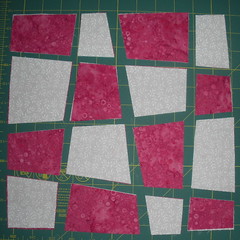
Assemble center units first1. Sew the center sections together first. If your block is going to come up short . . . best to find out right away, right?

As you are sewing the background to the head, the neck and the legs, press toward the dark. You don’t have to worry about any matching seams in any of this part of the block, so you can focus ENTIRELY on those 1/4 inch seams.

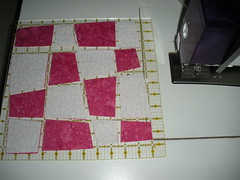
After all the backgrounds are attached, sew the sections together and . . . moment of truth time, measure the center section. From top to bottom, it should measure 6-1/2 inches.

Then sew the background pieces to the arms. I pressed the seams on those UP, which means the top seam is pressed toward the BACKGROUND, so I would have opposing seams at the shoulders–the ONLY matching seams you have in this block.


Assemble sides and attach them to center
2. After putting the center together, adding the arms is easily done . . . and so are you ;-)
Oklahoma Boomer Block

Thursday, April 30, 2009

Cactus Pot Quilt Block

Cactus Pot Quilt BlockThe Cactus Pot quilt block was first published in the Oklahoma Farmer Stockman, on January 1, 1930 in a monthly column that was included in the journal in the 20's and 30's called Good Cheer Quilt Patterns.

FABRICS

You'll need three fabrics for this block, which I will refer to as CACTUS, POT and BACKGROUND .

Note : if you are making this block for the May 2009 Block Lotto, at least one of your fabrics–it can be any of the three–must be be a flower print.

CUTTING

CACTUS Fabric CuttingFrom your CACTUS fabric:

One large triangle*, cut from a 3-7/8 inch square cut diagonally

Two 2-3/8 inch squares*


POT Fabric CuttingFrom your POT fabric:

One large triangle*, cut from a 3-7/8 inch square cut diagonally

Two small triangles, cut from a 2-3/8 inch square, cut diagonally


BACKGROUND Fabric cuttingFrom your BACKGROUND fabric:

One large triangle*, cut from a 3-7/8 inch square cut diagonally

Two 2-3/8 inch squares*

One 2 inch square

Two 2 inch by 3-1/2 inch rectangles

Note: The squares and triangles marked with asterisks* will be used to make half square triangle units. If you like to round up and trim afterward, these pieces can be cut larger.

SEWING THE BLOCK

Join the CACTUS and POT Large Triangles1. Sew the Large triangles of Cactus and Pot to form a square. It should measure 3.5 inches.
2. Use the 2-3/8 squares of Cactus and Background fabrics to make 4 half square triangle units. They should each measure 2 inches.

The squares of BACKGROUND and CACTUS fabrics form 4 HST Units

3. I find it helpful to lay out these units plus the square of background fabric, to make sure I have the cactus points going in the right direction before sewing them together . . . at least on the first block or two.

Sew two strips, one with two triangle units and the other with two triangle units and the background square.

Layout the triangle squares

4. First attach the strip with the 2 HST units.

Add joined HST units to one side

5. Then add the longer strip to the other side.

Add the other HST units to the other side

6. Next sew the two small Cactus triangles to the end of the Background rectangles.

You need to be very gentle when sewing and especially pressing these because of the bias edges at the “bottom” of this step.

Join POT small triangles to BACKGROUND rectangles

7. After these are sewn to the sides and, again, gently pressed to avoid stretching, the remaining, large background triangle (which should not be cut larger, will fit EXACTLY, to complete the block.

I left the “bunny ears” on the sides to make it a little easier to align the triangle at the bottom. If you trim first, the points will overhang a little so that after the seam is sewn, you have a straight edge.

Add Background triangle to the bottom

You’re done!

You're done

Saturday, April 18, 2009

Pat's Beautiful Disapearing 9-Patch Quilt

Since many people discovered this blog because of my playing around with the Disappearing 9-patch and putting pieced blocks in the corners, I have to share Pat K's quilt, Hearts and Roses.


It was her first attempt at a disappearing 9 patch using the scrappy hearts blocks she won in Block Lotto a little over a year ago. She said that she really enjoyed putting this together because of all the hearts from everyone. I just love how it turns out and the quilting designs she chose really compliment the piecing. She meandered around the blocks and stippled around the hearts. Her friend Diana quilted the border with a digital heart pattern.

Tuesday, March 31, 2009

Thrifty Block Pattern

Pink + Black + WhiteThe Thrifty block was first published in 1939 by the Kansas City Star, according to Barbara Brackman's Encyclopedia of Pieced Quilt Blocks.

It's a simple little block that has a lot of design possibilities. I'm thinking about putting some I-spy squares in place of the pink squares. It would make a great alternate block in a sampler quilt (or for a lot of the lotto blocks we make) or a border block. It could be a great swap block or scrap buster by keeping the 4-patch and center squares a consistent color and changing up the 4 squares (pink in my example).

To make a single six inch (finished size) block, you'll need small amounts of fabrics in three colors, illustrated here in Pink, White and Black:

Pink: One 2.5 inch by 10 inch rectangle (or a 5 inch square)
White: One 1.5 inch by 12 inch rectangle (or a pair of 1.5 x 6 inch rectangles if you are working from scraps, as I did)
Black: One 2.5 inch square plus One 1.5 inch by 12 inch rectangle (or a pair of 1.5 x 6 inch rectangles)

Tip: add 1/4-1/2 inch in length to the measurements to the rectangles to give yourself a little wiggle room to square up edges if necessary


Fabric requirements

1. Sew the black and white long rectangles together along the long edges.

2. Press the seam allowance toward the black side. Slice into eight 1.5 inch sub-units.

Press and cut eight 1.5 inch sub-units

3. Use these to sew four 4-patches. After your 4-patch units are sewn and pressed, they should measure 2.5 inches square.

Sew four 4-patches

4. Cut your Pink rectangle (or 5 inch square) into four 2.5 inch squares and lay out the units of your block, 9 patch fashion.

Units laid out as 9-Patch

5. Assemble your block.

Pink + Black + White


. . . And then, because that was so quick, make a couple more

Pink + Black + Black & White Pink + Black & White + White

Then, you might be inspired to pull out some more black and white and pink scraps and think about making some more . . .

Fabric Scraps I used to make blocks

Like I did ;-)

Pink + Black + White Thrifty block #15 Thrifty block #14
Thrifty block #13 Thrifty block #12 Thrifty block #11
Thrifty block #10 Thrifty block #6 Thrifty block #8
Thrifty block #7 Thrifty block #5 Thrifty block #9

The thing to be careful of when you make this block is that you always end up with a nice "X" and that your blocks don't look like this when your done.

An OOPS block example

It's easier than you think to OOPS . . . and I offer this photo as proof positive of that fact ;-)

Saturday, March 07, 2009

Jeweled Geese Block

After side strips have been addedI couldn't find a documented name for this block–a variation made of flying geese units. Since we are making it from jewel toned fabrics for the March 09 Block Lotto, Michelle dubbed it Jeweled Geese and it stuck.

It is basically constructed from three 2 x 4 inch geese units with 1 x 6 inch strips added at the sides to create a square 6 inch (finished size) block. There are three easy ways to make the block . . . starting with the one that uses my favorite method for making flying geese units, no-waste geese ;-)

Method 1 - one geese wasted (maybe)

You'll need:

One 5-1/4 inch square of jewel tone #1 (for the geese)
Four 2-7/8 inch squares of black (for the sky)
Two 1-1/2 inch by 6-1/2 inch rectangles of jewel tone #2 (for the side strips)

Fabric Requirements

Take the five squares and follow the directions on this site for no-waste geese. You'll have four geese units.

After the geese units are complete

Be sure to measure and square up your geese beofre continuing–you can thank me later ;-)

They should measure 2-1/2 by 4-1/2 inches. Choose the nicest three and assemble them like this.

Three geese units sewn together

NOTE: When you are putting together the geese units, be sure to sew them with the pointy side on top so you can see that you are sewing through the intersection at the top of the triangle (goose) so you will have a nice point and won't be hiding the "beak." Your seams will look something like this.

Note the intersections, to avoid losing your "beaks"

(Click any image for a closer look)

Sew the side strips to your three geese units and your block is completed.

One block completed

IF the one wasted goose unit bothers you . . . you can repeat the process two times more and make a forth block from the leftover geese. For the March block lotto, be sure to add different fabrics to the sides so that each block is a unique fabric combination.

Repeat three times, four blocks completed


Method 2 - making flying geese from strips (noodles or jelly rolls)

If you haven't wrapped your head around the no-waste method or are working with 2-1/2 inch noodles from a swap, a pretty jelly roll or other narrow pieces of fabric, this method may be the one for you.

For each block, you'll need

one strip 2-1/2 by 13-1/2 inches of jewel tone fabric #1 for the geese
one strip 2-1/2 by 15 inches of black fabric for the sky
one strip 1-12 by 13 inches of jewel tone fabric #1 for the side strips

Fabric requirements

Cut the geese fabric into three 2-1/2 by 4-1/2 rectangles. Cut the black sky fabric into six 2-1/2 squares. Cut two 1-1/2 by 6-1/2 side strips.

Make the geese units by laying one black square on top of a rectangle, right sides together, aligning the top, bottom and one side. Draw a diagonal line across the square, as shown, from the outside bottom corner, and sew along the line.

Begin by laying a background square on a rectangle

Cut away 1/4 inch outside your seam

Cut away the outside triangle, a quarter inch from your seam. Toss the excess fabric or sew it together for a bonus triangle square for a future scrap project . . . or you can send it to me ;-)

Press open.

Add a second square, right sides together on the other side and repeat the process. Draw the line, sew on it, cut away the excess fabric, a quarter inch away, sew the bonus triangle square (or toss it). Press open.

Press open, and add second square Repeat on second side

Rinse and repeat until you have made three geese units. Each unit should measure 2-1/2 by 4-1/2 inches. Take a moment and measure them and square up if necessary. Then sew the three together.


Three geese units completed Three geese units joined

Add the strips to the sides to form a 6-1/2 inch block with seam allowances–6 inch finished size.

After side strips have been added

I made these two blocks using this method . . .

Two jeweled geese blocks

. . . which gave me 12 bonus triangle squares (AKA half square triangles or HSTs) that became these pinwheel blocks. They'll measure 2-1/2 inchs (finished size) after they've been squared up.

Bonus - 3 pinwheels

Method 3 - paper foundation piecing

Flying Geese can always be paper pieced and this technique is especially attractive if you are designing geese that don't have the traditional proportions of half as tall as they are wide which makes piecing more challenging, or if you want your geese to fly along a curved path.

For our 6 inch block, you can download a paper piecing foundation pattern here.

Same block in a different colorway

Here's an example of other these geese blocks could look using different different color rules. I made these 9 inch blocks from 3 inch by 6 inch geese units from an anything goes swap and added 2 inch strips of the same tan fabric to all the blocks.


Sunday, March 01, 2009

Bringing the Block Lotto to Blogland

If you've been curious about the monthly block lotto thing I do (and updated in the sidebar monthly, even when this blog is woefully neglected) . . . but not curious enough to wade through the heavy, clunky interface and hundreds and hundreds of daily messages on the quilting forum, I may have good news for you. I've decided to move the Block Lotto to blogland and invite my friends and readers here to come play along. Everyone is welcome–if you are mildly curious, please come check it out.

The rules are simple. Make a block or as many as 9 to enter, following the rules for fabric and color. Your name is entered in the drawing at the end of the month for each block you make. For complete rules, follow the links in the sidebar for more complete info.

In March, we're making a variation of a Flying Geese block in jewel tones and black, based on an 1865 pieced silk quilt I saw at the Shelburne Museum in Vermont some years ago. Here are 24 blocks that have been made so far by Béatrice, Jill and Michelle.


I'm hoping some of those who have appreciate my tips and patterns here will come play and some of my friends in Michigan that I'm missing will come play and all of the Block Lotto crowd will continue to come play . . . and that bringing the block lotto to blogland turns out to be the right thing to do.

Sunday, February 10, 2008

Disappearing 9-Patch

When Christine mentioned using pieced blocks in the Disappearing 9-Patch pattern on the Quilting Forum, I thought it was brilliant. I immediately thought of the 6 inch patchwork heart blocks we're making this month for the block lotto and what a great setting this could be for them.

I had to try it . . . and then, I liked the results so much I had to share.

1. Start with 4 pieced blocks. (If you like these hearts, you'll find the pattern here.)

Red Heart Blue Heart
Green Heart Purple Heart

2. Add 5 squares of fabric the same size as the pieced blocks and make a 9-Patch with the pieced blocks in the corners. If your blocks have a right-side-up AND you want all the blocks to be right-side-up in the finished quilt, start with two of them, in diagonally opposite corners, upside down.

Make  A 9-Patch

3. Press your 9-patch block, then cut into 4 equal quarters.

Quarter the Block

4. Rotate the two upside down blocks (or any opposite corners if they are non-directional) and sew the 4-patch together.

Rotate 2 Opposite Corners

5. All done!

Disappearing 9-Patch with Pieced Blocks.